
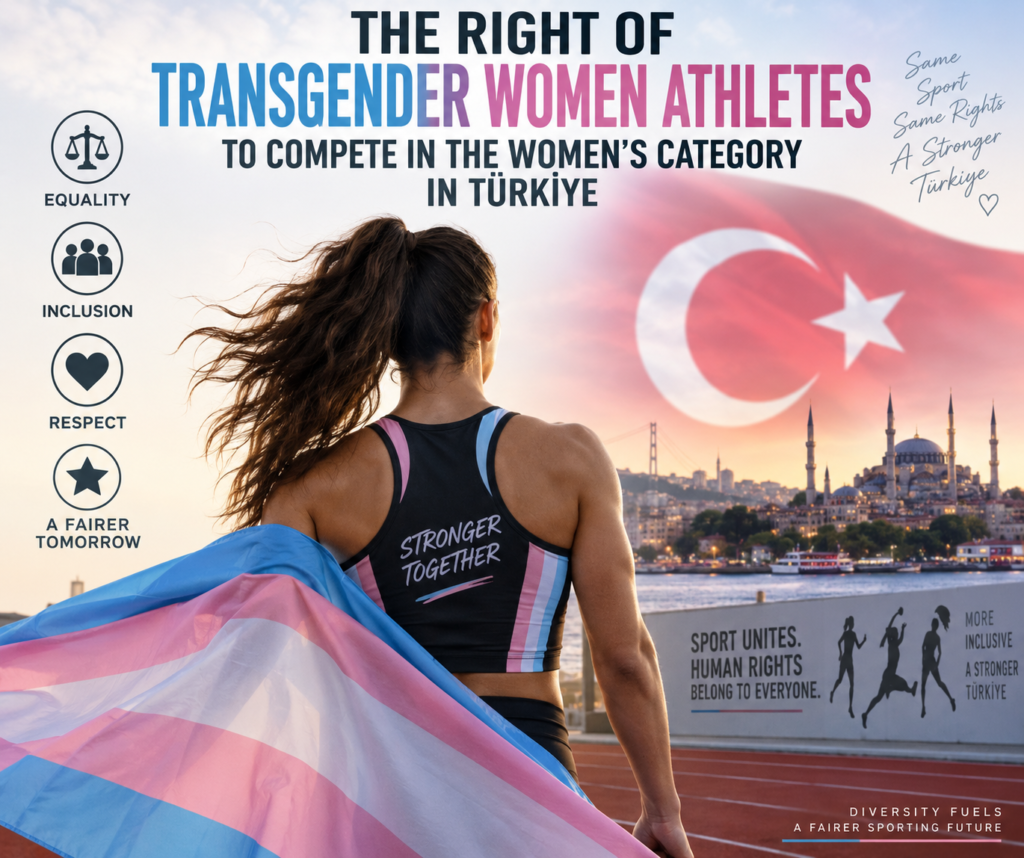
THE RIGHT OF TRANSGENDER WOMEN ATHLETES TO COMPETE IN THE WOMEN’S CATEGORY IN TÜRKİYE
Generally
Whether transgender women athletes may compete in the women’s category is one of the most contested issues in international sports law today.
The debate pits the prohibition of discrimination based on gender identity and personality rights against the principle of “fair and meaningful competition” in sport.
In Türkiye there is no separate legislation specific to this issue; instead, it is shaped by general legal provisions and by the rules of the international sports federations to which Turkish federations belong.
Turkish Law Framework
Article 40 of the Turkish Civil Code (Law No. 4721) allows for a change of legal sex with court authorisation.
The person must apply to the court in person; once the surgery carried out under that authorisation is confirmed by an official medical board report, the court orders the correction of the civil registry.
The original version of the article requirement of “permanent loss of reproductive capacity” (sterilisation) was annulled by the Constitutional Court in a 2017 decision, a ruling that aligns with the reasoning of the European Court of Human Rights in Y.Y. v. Turkey of 10/06/2015. Today, under Turkish law, correcting one’s legal sex is no longer conditioned upon compulsory sterilisation, but the process still requires a court order and surgery distinguishing it from the ‘self-identification’ model adopted by some European countries.
Sports Regulation: No Separate Rule — the International Rule Applies
Law No. 3289 on Youth and Sports Services and the individual sports federations’ regulations contain no Türkiye-specific rule on which category a transgender athlete may compete in. However, bodies, such as the Turkish Athletics Federation and the Turkish Swimming Federation, are affiliated with international governing bodies of World Athletics, World Aquatics, and others, and under those bodies’ statutes, the eligibility rules set by the international sports federations are binding upon the national sports federations and the competitions that they organise. In other words, the issue is not that different rules apply in domestic versus international competitions; rather, Türkiye has not set its own policy and simply adopts the rules of the international sports federation with which each sport is affiliated.
These rules vary considerably from one international sports federation to another.
In 2021, the International Olympic Committee (IOC) issued a framework abandoning its earlier uniform testosterone-threshold policy and leaving the decision to each sports federation. As a result, World Athletics, in 2023, excluded transgender women athletes, who had gone through male puberty, from women’s category world-ranking competitions altogether; World Aquatics imposed a similar Tanner-stage requirement; and World Rugby removed transgender women athletes from the category entirely. Some federations, by contrast, maintain an inclusive, self-identification-only model. Turkish sports federations apply whichever of these models their respective international federations have adopted.
In March 2026, the IOC announced a new policy that bans transgender women athletes from competing in the female category at the Olympic Games.
The Constitutional Tension
Article 10 of the Turkish Constitution guarantees equality; Article 17 protects personal rights; and Article 20 protects the privacy of private life.
Denying transgender women’s participation in the women’s category could raise discrimination claims under these provisions; whilst protecting the fairness of the women’s category is also a legitimate interest.
The European Court of Human Rights’ ruling in Hämäläinen v. Finland of 16 July 2014 shows that states are afforded a margin of appreciation in this area, but that this margin is not unlimited.
Turkish courts have not yet developed any direct case law on this specific issue.
Conclusion
The legal uncertainty surrounding transgender athletes in Türkiye does not stem from a gap in domestic legislation as such, but from the fact that this gap is filled by the rules of international sports federations, whose rules are themselves inconsistent with one another.
It would improve legal certainty if the Turkish Ministry of Youth and Sports and the national sports federations adopted a transparent procedure for incorporating the applicable international sports federations’ rules into domestic regulations, including a clear avenue for athletes to appeal decisions.
We advise and represent clients in transgender cases in sport in Türkiye and further information is available by emailing the Head of our Turkish Law Practice, Gurur Gaye Günal, at gunal@valloni.ch.