
FIGHTING RACISM IN FOOTBALL IN ISRAEL
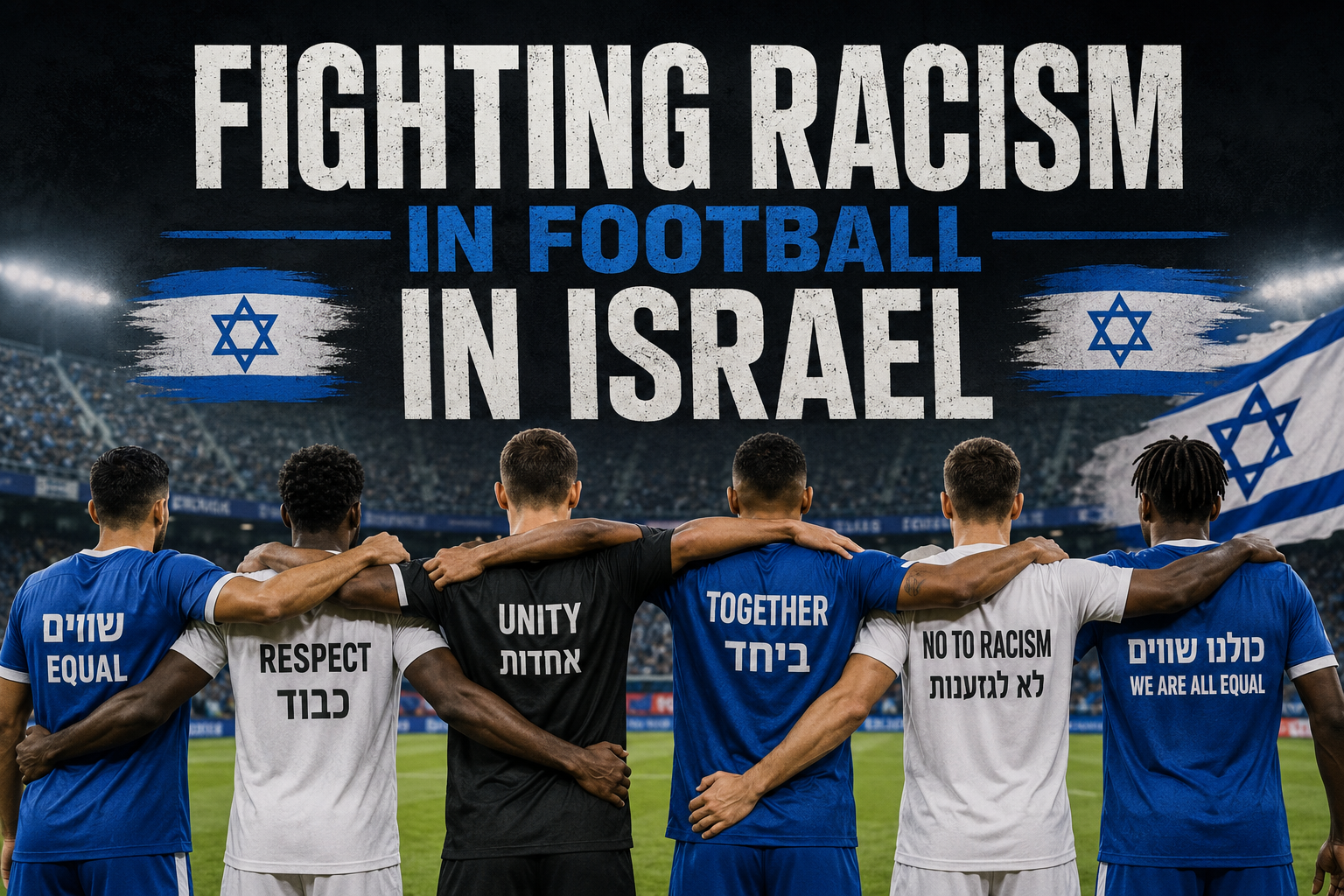
Racism in football continues to be a blemish on the beautiful game in many parts of the world, including Israel.
Reports by Givat Haviva’s “Kick It Out” programme, which monitors racism and violence in Israeli football, have identified a continuing rise in racist chanting and violent incidents in Israeli football stadiums. In the 2024/25 season, 367 incidents of racist chanting were recorded in the Israeli Premier League. The trend has continued into the 2025/26 season, with the first-round report recording 130 racist chants and 115 violent incidents.
The reported chants include anti-Arab expressions, references to the war in Gaza, and other discriminatory or degrading language. The same monitoring reports also refer to isolated incidents involving disrespect towards the Israeli national anthem and to chants trivialising the memory of the Holocaust.
From a legal perspective, the fight against racism in Israeli football lies at the intersection between the State legal order and the sports regulatory system.
Racist conduct in stadiums may give rise to criminal-law consequences under Israeli law, whilst also triggering disciplinary proceedings under the rules of the Israel Football Association (IFA) and, in international contexts, under FIFA and UEFA regulations.
The Israeli legal framework
- The Prohibition of Violence in Sport Law 5768-2008
Israel addresses racism in sport through a combination of general criminal-law provisions, sports-specific legislation and football disciplinary rules.
At State-law level, the most relevant statute for football stadiums is the Prohibition of Violence in Sport Law 5768-2008. This law is an Israeli statute enacted to prevent racism and violence at sporting events. It facilitates the training and deployment of security personnel; broadens the legal definition of racist displays; expands the authorities of stadium staff; and establishes an ongoing Committee for the Prevention of Violence in Sport.
- Penal-law provisions on racism and incitement
In addition to sports-specific legislation, the Israeli Penal Law 5737-1977 contains general provisions dealing with racism and incitement.
Section 144A of the Penal Law defines racism as persecution, humiliation, degradation, a display of enmity, hostility or violence, or causing violence against the public or parts of the population because of colour, racial affiliation or national ethnic origin.
Section 144B criminalises a publication intended to incite racism. The offence does not require proof that the publication actually caused racism. It is sufficient that the publication was made with the intention to incite racism. The penalty may be up to five years’ imprisonment.
Section 144D2 criminalises incitement to violence or terror, where a person publishes a call to commit an act of violence or terror, or words of praise, support or encouragement for such acts, and where, considering the content and circumstances of the publication, there is a real possibility that it will lead to acts of violence or terror.
In addition, section 144F provides that offences motivated by racism or hostility towards the public may constitute an aggravating circumstance. This may lead to increased penalties for certain offences against the body, liberty, property, threats, extortion, public order or public service.
In the football context, these provisions may become relevant where racist chants, slogans, banners, social-media publications or violent conduct go beyond general offensive behaviour and satisfy the elements of criminal offences. This is particularly important where expressions are directed against a protected group, glorify violence, or create a real risk of violent escalation.
- The Israel Football Association disciplinary framework
Alongside State law, football in Israel is regulated by the disciplinary system of the IFA.
The IFA Disciplinary Regulations provide an autonomous sports-law framework for dealing with misconduct by clubs, players, officials and supporters. This framework is important because it allows disciplinary action to be taken within football even where the conduct is not prosecuted criminally, or where individual offenders cannot be identified.
The IFA regulations define racist and offensive chants broadly. The relevant provisions cover oral or written expressions, conduct or gestures that harm the dignity of a person or group on grounds such as skin colour; race; religion; language; political opinion; ethnic origin; disability; gender or sexual orientation. The definition also includes racist noises by supporters; inappropriate expressions making use of the Holocaust; expressions disrespecting the national anthem; and conduct harming state symbols; where such conduct is recorded in a referee report, match observer report or supported by other prima facie reliable evidence.
This means that conduct in football stadiums may have disciplinary consequences even when it does not lead to criminal proceedings. The threshold for sports discipline is not necessarily identical to the threshold for criminal liability. Football disciplinary bodies may, therefore, act against clubs for supporter conduct on the basis of match reports, observer reports or other reliable evidence.
The IFA disciplinary system also provides for sanctions against football clubs. These may include warning; financial penalties; restrictions on ticket sales for away matches; points deductions; and, in serious cases, broader sporting sanctions. The disciplinary framework, therefore, seeks to create incentives for clubs to prevent racist conduct; cooperate with enforcement authorities; and act against supporters who engage in discriminatory behaviour.
The FIFA disciplinary decision against the Israel Football Association
The issue has also reached the international disciplinary level. On 19 March 2026, the FIFA Disciplinary Committee sanctioned the IFA after examining allegations of discrimination raised by the Palestine Football Association and mandated for investigation by the FIFA Council.
FIFA found that the IFA had committed multiple breaches of its obligations as a FIFA member association, in particular, under Article 13 of the FIFA Disciplinary Code, concerning offensive behaviour and violations of the principles of fair play, and Article 15, concerning discrimination.
The sanctions imposed by FIFA included a fine of Sw. Frs. 150,000; a warning regarding future conduct; and a mandatory prevention plan. FIFA ordered the IFA to display a prominent “Football Unites the World – No to Discrimination” banner at its next three home matches in A-level FIFA competitions. FIFA also required that one third of the fine be invested in a comprehensive prevention plan, subject to FIFA approval, focusing on reforms, protocols, monitoring and educational campaigns in stadiums and official channels for an entire season.
From a sports-law perspective, the decision is significant because it underlines that a national association may face disciplinary responsibility not only for isolated incidents, but also for broader failures in prevention, monitoring and enforcement. It also reflects the increasing use of corrective measures, such as action plans and education programmes, alongside financial sanctions.
Domestic enforcement and institutional responsibility
The Israeli legal and regulatory framework already recognises racism and violence in sport as matters requiring intervention. However, the practical challenge remains enforcement. The ‘Kick It Out’ programme has repeatedly stressed that existing legal and disciplinary tools are not always used effectively and that, in practice, many incidents do not lead to meaningful consequences. This points to a gap between the number of racist incidents that are recorded in stadiums and the number of disciplinary or criminal proceedings that are actually initiated.
The Israeli context, however, presents particular sensitivities. Football stadiums may reflect wider social and political tensions. Anti-Arab racism, antisemitism, Holocaust-related abuse, disrespect of national symbols and conflict-related slogans may all appear in football environments. For that reason, enforcement must be principled, consistent and legally sound. Selective enforcement risks undermining trust, whilst under-enforcement risks normalising discriminatory conduct.
A credible anti-racism framework requires an integrated strategy involving criminal-law enforcement in serious cases; consistent disciplinary action by sports bodies; reliable monitoring and reporting; education and awareness programmes; support for victims and witnesses; individual accountability for offenders; cooperation with fan organisations; and clear responsibility of football clubs and associations.
This approach is also consistent with the recent global work of FIFA and the United Nations Office on Drugs and Crime, which has emphasised the need for stronger criminal justice responses; victim-centred reporting mechanisms; and better legal and policy frameworks to combat racism in football.
For further information and advice on racism in football in Israel, email Kim Gamboni at gamboni@valloni.ch.