
FIGHTING MONEY LAUNDERING IN FOOTBALL IN GERMANY
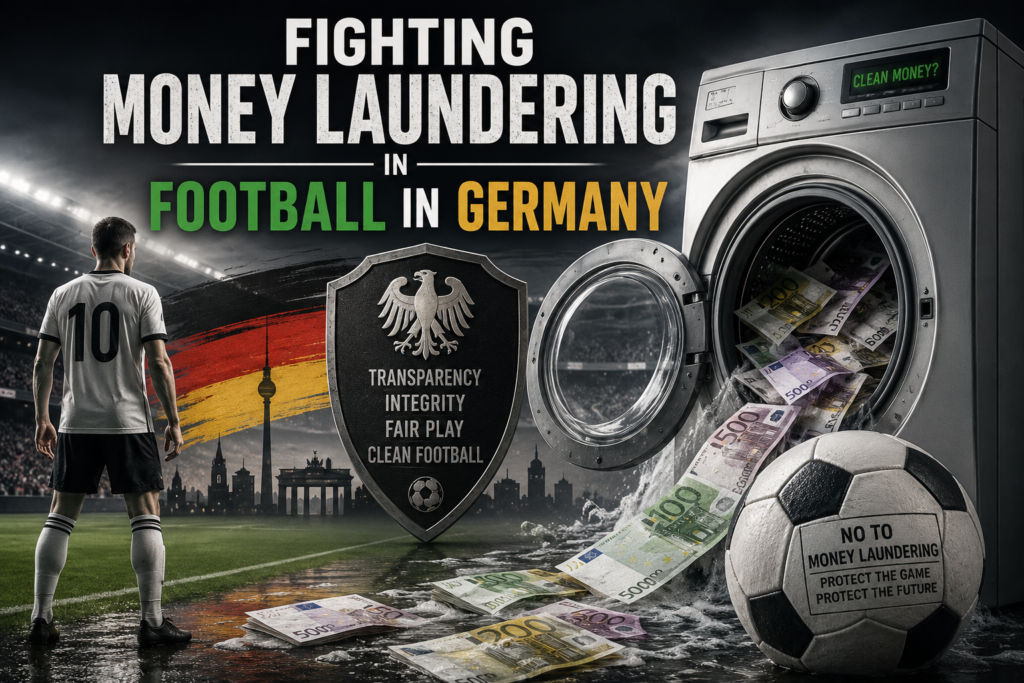
Professional football clubs and agents in Germany are coming under increasing scrutiny as a result of a forthcoming important package of anti-money laundering legal measures under the European Union (EU) Anti-Money Laundering Regulation (AMLR).
In fact, German professional football clubs and agents officially become „obliged entities“ under the AMLR and, as such, they must fully streamline their corporate structures; operate a strict compliance function; and standardise their operations by 10 July 2029.
Compliance with these important measures will be overseen by the new EU Anti-Money Laundering Authority (AMLA).
The AMLA has its headquarters in Frankfurt in Germany.
In addition, the German legislature will designate a national watchdog to enforce checks on football clubs.
Particular areas of scrutiny include:
- Opaque Player Transfers: High-volume, border-crossing transfers moving through complex networks of foreign intermediaries constitute major channels for masking dirty cash.
- Corporate Shell Investments: Criminal syndicates exploit financially vulnerable clubs by injecting illicit cash through complex layers of offshore companies and front owners.
- Inflated Sponsorship Deals: Overvalued, cross-border commercial and advertising partnerships are widely used to cycle cleanly dirty money into clubs’ balance sheets.
- Ticket and Ticket-Resale Systems: Opaque, cash-heavy matchday operations, ticket allocations, and parallel corporate hospitality schemes constitute secondary exploitation risks.
Compliance obligations include:
- Customer Due Diligence: Clubs must carry out identity and background checks on all investors, player transfers, and sponsorship deals exceeding €10,000 (around Sw. Frs. 9,000).
- Ultimate Beneficial Ownership: Clubs are strictly required to trace, map, and verify the true human owners behind corporate sponsors and incoming investors.
- Suspicious Activity Reporting: Compliance officers must flag, log, and immediately report unusual financial patterns to government financial intelligence units.
- Cash Limit: Clubs may not accept cash payments of over €10,000 thus requiring larger sums to be processed through the traceable banking system, with a view to limiting the anonymity of money launderers.
German football clubs are already under other major scrutiny measures regarding corruption, tax evasion, and ticket irregularities.
For example, on 1 July 2026, the German police deployed over 150 officers to raid the headquarters of the German Football Association and municipal town halls in relation to suspected illegal ticket and hotel allocations relating to the 2024 Euros, which were held in Germany.
For further advice and legal representation in money laundering cases, email Dr Lucien Valloni at valloni@valloni.ch.