
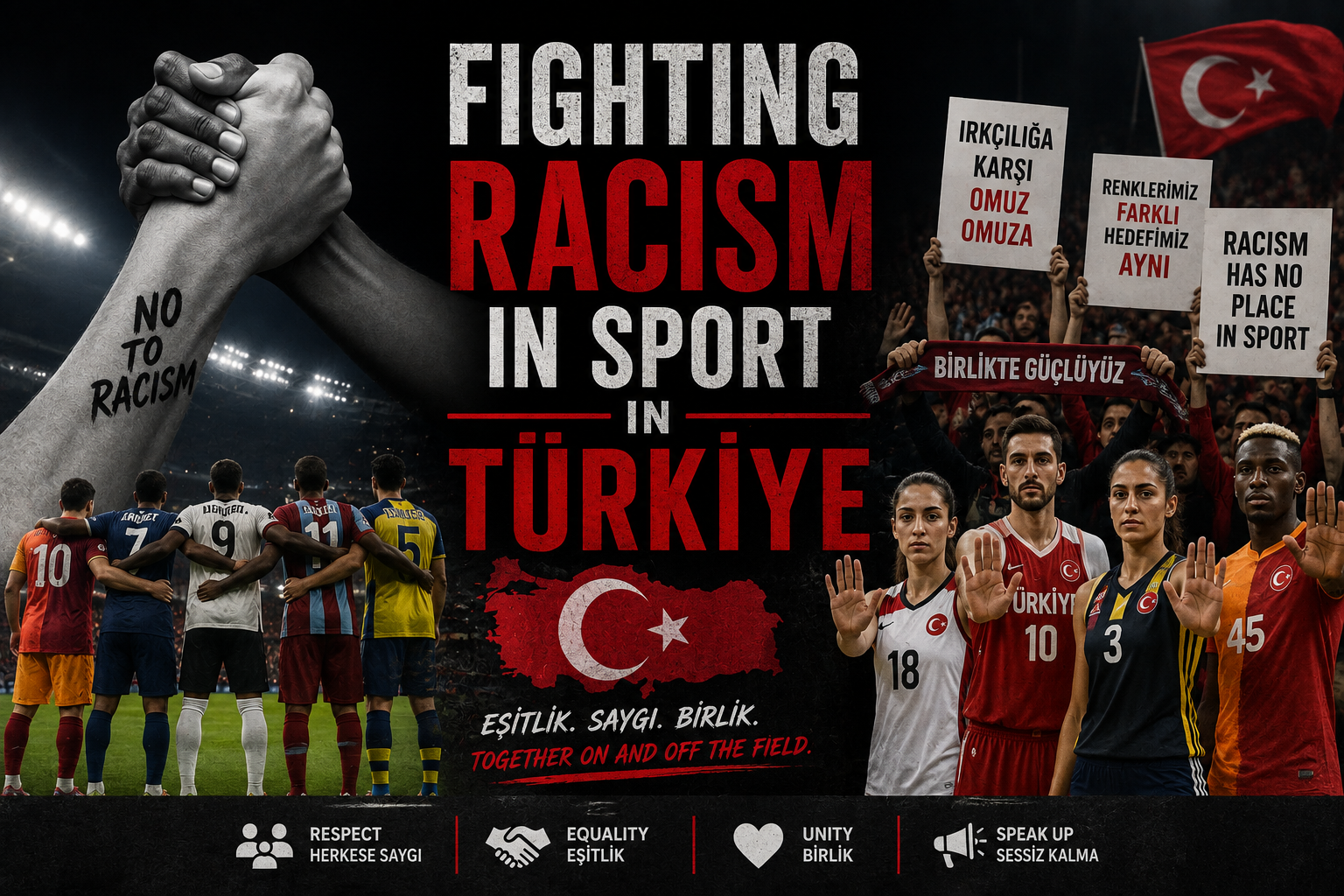
FIGHTING RACISM IN SPORT IN TÜRKİYE
Legal and Disciplinary Framework
Whilst sports, by virtue of their universal values, ought to serve as a unifying force, they can occasionally become the target of racist and discriminatory acts both in the stands and on the pitch.
Turkish sports law has developed a comprehensive sanction mechanism to combat such acts that violate human dignity. Legal sanctions enforced against racism and discrimination in Turkish sports venues are addressed under three main dimensions: judicial/criminal law, administrative security measures, and autonomous sports disciplinary law.
This Post examines the legal grounds provided by the Turkish legal system against racism in sports organisations and their alignment with international standards, particularly football.
- Judicial and Statutory Dimension: Law No. 6222
Under Turkish criminal legislation, offences committed in sports venues are regulated by Law No. 6222 on the Prevention of Violence and Disorder in Sports. The law criminalises racist statements and acts, subjecting them to severe penalties.
Offence of Insult and Discriminatory Chanting (Article 14/2): Individuals who utter insults or engage in behaviour targeting segments of society based on religion, language, race, ethnic origin, gender, or sect in or around sports venues are punished with imprisonment from 1 to 3 years .
Ban from Attending Sports Events (Article 18): As soon as a criminal investigation is initiated against an individual for racist chanting or actions, a „Ban from Attending Sports Events“ (stadium/Passolig restriction) measure is immediately imposed. These individuals are obliged to report to police stations and sign in on the match days of the teams that they support.
Example: Law enforcement authorities initiated judicial proceedings under Article 14/2 of Law No. 6222 against fans in Turkish leagues who waved bananas at players opposing or engaged in racist chants targeting ethnic/religious identities; their Passolig cards were blocked, and they were banned from entering stadiums.
- Disciplinary Law Dimension: TFF Football Disciplinary Instruction
The Turkish Football Federation (TFF), within its autonomous structure, considers racism to be one of the most severe disciplinary violations. Pursuant to Article 42 (Discrimination) of the TFF Football Disciplinary Instruction (FDI), the following sanctions are applied depending upon the perpetrators:
Players: Players engaging in discriminatory acts that violate human dignity face a ban from 4 to 8 matches.
Club Executives and Officials: They face a deprivation of rights penalty alongside substantial monetary fines.
Liability of Clubs: If supporters or club members engage in racist rhetoric, monetary fines are imposed upon the club. Depending upon the severity or recurrence (recidivism) of the violation, severe penalties, such as playing matches without spectators, stadium closures, points deductions, and expulsion from the league come apply.
Example: In past seasons, the TFF Professional Football Disciplinary Board (PFDK) has imposed multi-match bans and deprivation of rights penalties under Article 42 of the FDI on players and executives accused of uttering ethnic/racist slurs on the pitch against opposing players or referees, or making discriminatory social media posts. Furthermore, clubs, whose fans engaged in collective racist chanting faced block closures and were forced to play matches behind closed doors, in addition to receiving heavy monetary fines.
- International Framework and Integration
Turkish sports law operates in alignment with global sports governance rules. Article 13 of the FIFA Disciplinary Code and Article 14 of the UEFA Disciplinary Regulations prescribe a minimum 10-match ban for players engaging in racist acts, as well as severe stadium closure penalties for clubs. The TFF Legal Boards base their decisions on these universal standards both when enforcing domestic legislation and when resolving international disputes.
Example (International Reflection): During a UEFA Champions League match between PSG and Istanbul Başakşehir, both teams walked off the pitch after the 4th official used a racist expression towards the Istanbul Başakşehir assistant coach Pierre Webó. Following the incident, the UEFA Disciplinary Committee launched an investigation and suspended the referee until the end of the season. This incident serves as a prominent example of the stance taken by Turkish clubs and the TFF against racism on the international stage.
- High-Profile Controversies and Case Precedents
- Domestic Players and Managers Incidents
Racism and derogatory conduct in the Süper Lig regularly attract international attention due to the high stakes of rivalry.
The Emre Belözoğlu – Didier Zokora Incident: In a high-profile case of racial abuse between players, former Fenerbahçe player Emre Belözoğlu was disciplined and banned by the TFF for directing racially insulting language at Trabzonspor player Didier Zokora during a match.
The Mourinho Controversy: Following an Istanbul derby against Galatasaray, Fenerbahçe manager José Mourinho faced severe accusations of racism and making derogatory remarks towards the Turkish public after stating that the opposing bench was „jumping like monkeys“ and claiming a Turkish referee would have ruined the game. Galatasaray launched formal legal complaints, leading the TFF to issue a multi-game ban, whilst Fenerbahçe rejected the allegations and initiated counter-legal actions.
- International Framework and UEFA Interventions
As mentioned, Turkish sports law and its stakeholders operate in direct connection with global governance frameworks, such as Article 13 of the FIFA Disciplinary Code and Article 14 of the UEFA Disciplinary Regulations:
Example Demiral (Euro 2024): UEFA opened a disciplinary investigation against Turkish defender Merih Demiral following an on-pitch celebratory gesture during Euro 2024, which authorities and UEFA deemed politically charged and xenophobic, resulting in a multi-match suspension.
Conclusions
Turkish sports legislation adopts a „zero tolerance“ policy towards racism and discrimination.
A supporter engaging in racist chanting in the stands faces prosecution under Article 14/2 of Law No. 6222, with a potential prison sentence of 1 to 3 years, along with a ban from entering stadiums.
If players or officials on the pitch commit such an act, it is met with long-term bans and deprivations of rights imposed by the TFF.
The real-life precedents and sanctions applied clearly demonstrate the deterrent nature of the legal framework and the legal commitment of keeping Turkish sports venues free from racism.
We act in racism cases in football and other sports in Türkiye, and further information and advice is available from the Head of our Turkish Law Practice, Gurur Gaye Günal, by emailing her at gunal@valloni.ch.