
SPORTS CORPORATE HOSPITALITY PACKAGES AND EU COMPETITION LAW
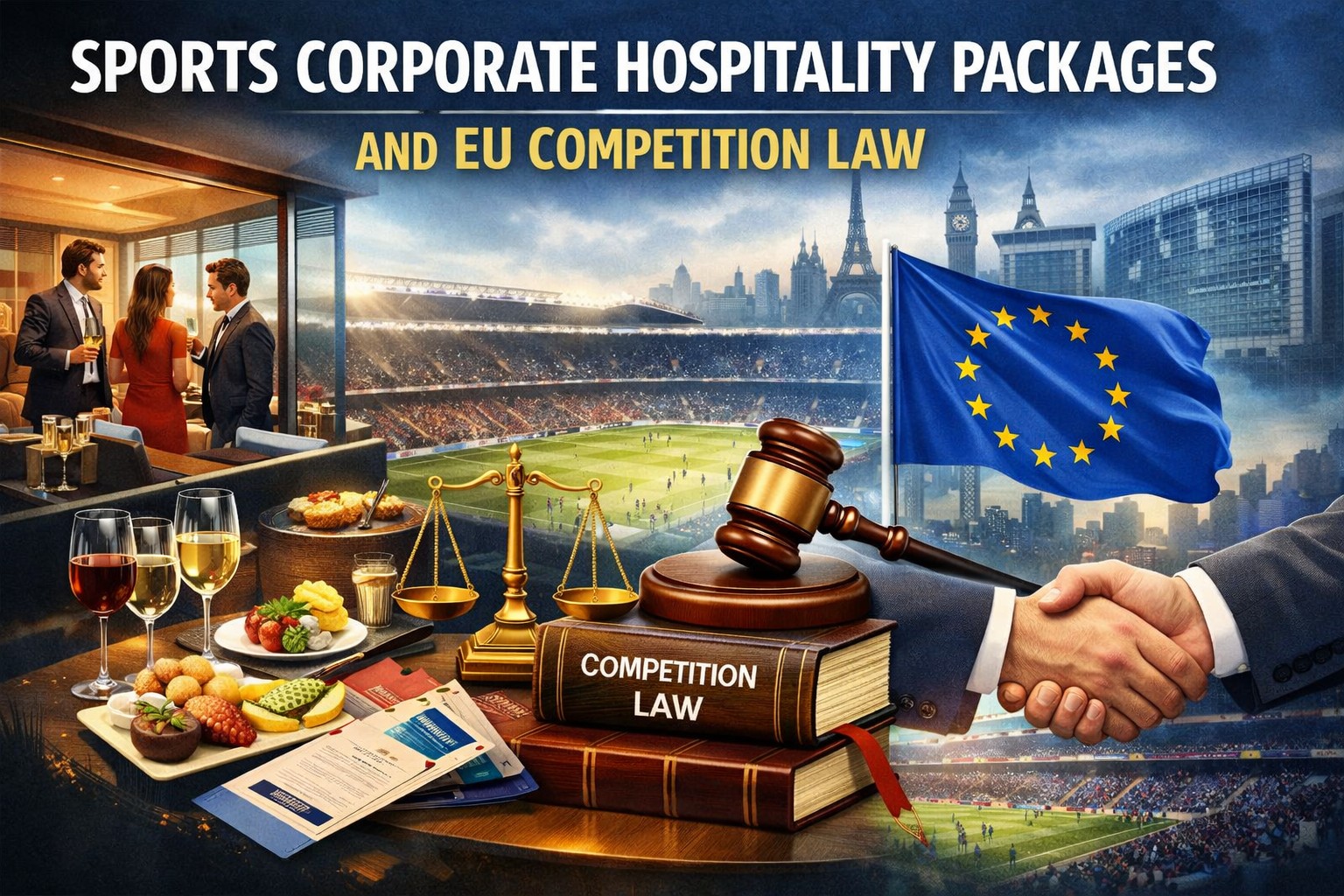
Luxury is not merely a matter of personal taste: it is a social construct that shapes access, status, and value, especially through the growing market of sports events hospitality.
From VIP lounges to private boxes overlooking the pitch, hospitality has become a central feature of how major sports events are consumed. These packages do more than offer seats; they curate experiences, forge business ties, and project brand identity. In many ways, they are the face of modern sports commercialisation.
But, as the offerings become more exclusive, the underlying legal questions become more pressing. Who controls access to these experiences? Under what conditions? And how do rules governing the allocation or resale of hospitality packages interact with the principles of European Union (EU) competition law?
Over the past decade, the EU has made it clear that sport is not exempt from antitrust scrutiny. Whilst the unique structure of sports governance, based on cooperation amongst rivals, is acknowledged, it does not shield commercial conduct from legal review.
Article 101 of The Treaty on the Functioning of the European Union (TFEU) prohibits agreements between undertakings that restrict competition, such as price-fixing or market sharing. In the context of sports hospitality, rules that limit the resale of tickets or packages may also raise competition concerns, particularly where they restrict access or exclude other operators.
Article 102 TFEU prohibits the abuse of a dominant position, especially where it harms consumers or forecloses competition.
Hospitality packages, often involving exclusive rights, resale restrictions, and premium pricing, may trigger scrutiny under both provisions.
Although sport enjoys some specific characteristics that justify coordination between competing entities, such as maintaining competitive balance or organising joint events, the Court of Justice of the European Union (CJEU) is increasingly examining how sports rules and commercial practices impact competition. The line between necessary coordination and unlawful restriction is under sharper review.
As confirmed in Meca-Medina (C-519/04) and reiterated in ISU v Commission (C-124/21 P) and European Super League (C-333/21), sporting rules and commercial practices must be assessed in the light of EU competition law, particularly when they restrict market access or foreclose competitors.
For instance, exclusive arrangements between sports events organisers and hospitality providers may limit the ability of other operators to compete and have access to this market. Where only one official hospitality partner is appointed, without transparent selection procedures, competitors may be foreclosed from the market. At the same time, high entry barriers, whether in the form of premium pricing or resale limitations, may restrict consumer choice and distort the market for tickets and related services. If the entity involved holds a dominant position, such as a governing body or a venue operator, these practices may also fall under the scope of Article 102 TFEU, particularly where they result in the exclusion of competitors or cause harm to consumers.
The rules surrounding the allocation and resale of tickets, particularly for hospitality packages, can also raise concerns. For example, if tickets are disproportionately allocated to a small group of preferred clients or corporate entities, or if resale is prohibited without objective justification, the practice may be deemed anti-competitive under EU competition law.
By its very nature, hospitality offers a premium experience. But when the rules surrounding it become opaque or overly restrictive, legal risks emerge. The CJEU is increasingly classifying certain practices, such as blanket bans on resale or exclusivity without competitive tender, as anti-competitive “by object”, meaning that they are inherently unlawful, regardless of proven market effects. This makes it more difficult for sports events organisers to defend such restrictions based solely on efficiency or quality arguments.
A timely example is the forthcoming 2026 FIFA Men’s World Cup.
Appointed as the exclusive official hospitality provider, the US Corporation, On Location, headquartered in New York City, offers a wide range of packages for all 104 matches across 16 venues of the 2026 World Cup. These packages include everything from pitch-side lounges and VIP suites to gourmet dining and entertainment, with prices at around US$ 2,000 (around Sw. Frs. 1,594) per person per game and rising steeply to substantially higher sums for the semi-finals and final. The offer is polished, global, and tailored to the luxury market.
Yet, from a legal perspective, such exclusivity raises questions. What if local operators or travel agencies want to provide alternative packages? What happens when resale is restricted, leaving consumers with no option but to buy from a single authorised source at premium prices? Whilst FIFA warnings against unofficial channels are intended to protect consumers and prevent fraud, such restrictions may, nonetheless, raise EU competition law concerns where they significantly limit access to the market or exclude alternative providers.
Real-world examples highlight how competition may be affected. Exclusive deals between sports organisations and selected hotels could limit access to accommodation near venues and inflate prices. Similarly, overly strict rules on ticket resale may reduce availability and push consumers into informal or inflated markets, further distorting competition.
The issue is not whether sports corporate hospitality packages, as expressions of luxury and exclusivity, should exist in sport: they do, and they likely always will. What matters is how such offerings are structured, priced, and governed in such a way that complies with EU competition law and preserves fair access. As the boundaries between entertainment, branding, and competition law continue to blur, legal vigilance becomes essential.
Ultimately, as sports events continue to attract global attention and commercial sophistication, the legal framework surrounding their organisation must evolve in tandem. Hospitality packages, whilst designed to elevate the spectator experience, cannot operate in a legal vacuum. Their structure, pricing, exclusivity, and distribution all have implications for competition, in a business and economic sense, and consumer access.
Restricting access to sports corporate hospitality packages for certain groups, such as fans, small businesses, or non-sponsors, may be seen as unjustified exclusion. When pricing is excessive or resale is broadly prohibited, without any proportionate justification, it may limit consumer choice and lead to inflated prices. Where such practices occur, they may fall foul of Article 101 TFEU and when imposed by dominant entities, they may also raise concerns under Article 102 TFEU.
Sports organisations and hospitality providers must, therefore, ensure that their commercial and marketing practices comply with EU competition law. Legal advice should be sought when designing or negotiating such packages to ensure that access, pricing and exclusivity do not create unintended barriers to the sports hospitality market or expose stakeholders to any enforcement risks.
Failure to comply with EU competition law may expose businesses to serious legal and reputational consequences, making it vital for stakeholders to identify risk factors at an early stage. In a sector where prestige meets regulation, anticipating legal exposure is not just a matter of compliance, but a mark of strategic foresight!
We act in all aspects of corporate hospitality for sports events at the national and international levels, including EU competition law issues and disputes. For further information, email Dr Estelle Ivanova or Prof Dr Ian Blackshaw at ivanova@valloni.ch and blackshaw@valloni.ch respectively.