
FIGHTING MONEY LAUNDERING IN FOOTBALL IN FRANCE
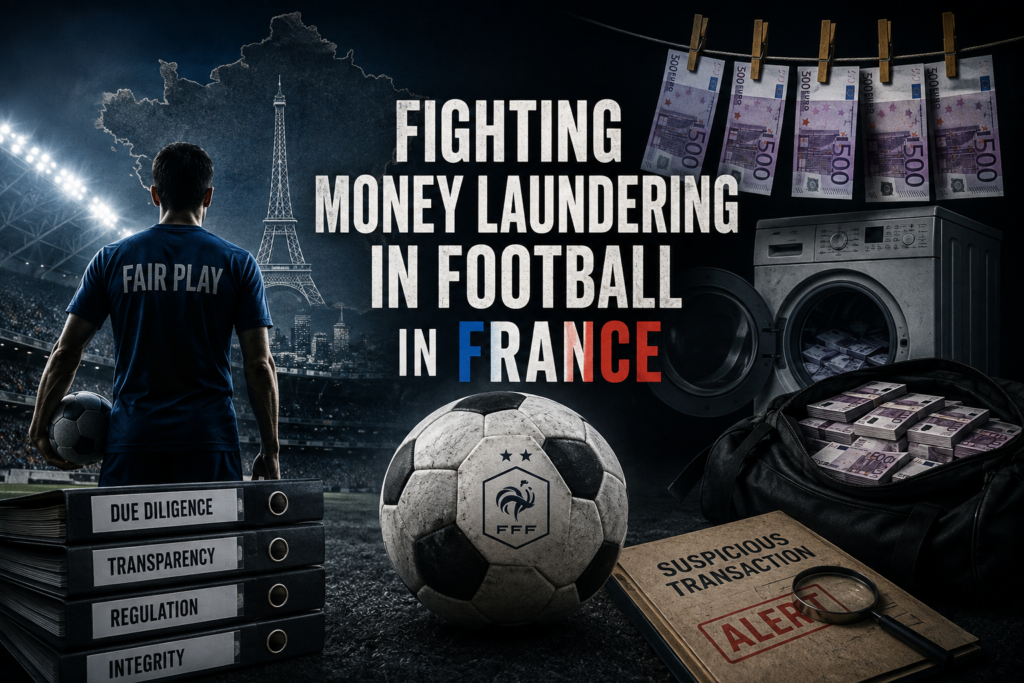
Money laundering is a modern scourge globally, involving trillions of dollars, and sport, in general, and association football, in particular, is vulnerable to money laundering.
This is due to the eye-watering financial flows generated by football club acquisitions, international player transfers, sponsorship agreements and other cross-border football-related commercial transactions.
In fact, the international nature of ‘the beautiful game’, combined with increasingly sophisticated and opaque ownership structures and the involvement of several intermediaries, including agents, particularly lends itself to hiding illicit funds.
Against this background, France has developed a robust system of financial oversight for football, which will soon be complemented by a new European Union (EU) Anti-money Laundering (AML) legal framework, which will extend specific compliance obligations to professional football clubs and football agents.
At the national level, financial oversight is primarily exercised in France through the Direction Nationale du Contrôle de Gestion (DNCG), which is the independent financial regulator operating within the framework of the Ligue de Football Professional.
Although the DNCG is not an anti-money laundering authority in the strict legal sense, it plays a significant preventative role by promoting financial transparency and safeguarding the economic integrity of professional football.
Through its financial supervision, the DNCG reviews football club budgets, payrolls, transfer operations and financing arrangements to ensure that clubs remain financially viable and that their resources are properly documented.
Where financial irregularities are identified, the DNCG may impose a range of sporting and financial sanctions, including transfer restrictions, salary controls or relegation.
Criminal investigations involving suspected financial offences within professional football may also fall within the jurisdiction of the Parquet National Financier, reflecting the growing attention paid by French authorities to complex financial transactions involving the sports sector in general and football in particular.
At the European level, the EU has introduced a major legislative reform through the Anti-Money Laundering legal framework, which was adopted in June 2024.
This comprises Regulation (EU) 2024/1624 (AMLR); Directive (EU) 2024/1640 (AMLD6); and Regulation (EU) 2024/1620, which establishes the new Anti-Money Laundering Authority (AMLA). Unlike previous anti-money laundering directives, the AMLR establishes a directly applicable “single rulebook”, which ensures greater consistency and harmonisation of anti-money laundering obligations throughout the EU.
The most significant innovation, which was introduced by the AMLR, is the inclusion, for the first time at the EU level, of professional football clubs and football agents within the EU Anti-money Laundering legal framework.
The AMLR defines both “professional football clubs” and “football agents” (Article 2(52) and (53)) and classifies football agents as “obliged entities”, whilst professional football clubs become subject to anti-money laundering obligations in relation to specific categories of transactions, namely, those involving investors, sponsors, football agents or other intermediaries, and player transfers (Article 3(3)(n) and (o)).
From 10 July 2029, professional football clubs in France will be required to implement comprehensive anti-money laundering compliance programmes.
These programmes will include adopting a risk-based anti-money laundering policy; conducting customer due diligence on investors, sponsors, commercial partners, intermediaries and other counterparties; identifying and verifying beneficial ownership; monitoring business relationships and transactions on an ongoing basis; reporting suspicious transactions to the competent authorities; and complying with the EU-wide €10,000 (around Sw. Frs. 9,268) limit on cash payments, without prejudice to lower thresholds that may be adopted by Member States.
To comply with these obligations, French football clubs will also need to establish appropriate internal governance arrangements; designate a person responsible for anti-money laundering compliance; implement effective internal control mechanisms; and provide adequate training for staff who are exposed to money laundering risks.
Football agents, who are already subject to anti-money laundering obligations under French law, will also be required to comply with the EU Anti Money Laundering legal framework.
We provide advice and legal representation in money laundering cases in football in France, and further information is available from Dr Lucien Valloni by emailing him at valloni@valloni.ch.