
NO-POACH AGREEMENTS IN FOOTBALL AND EU COMPETITION LAW
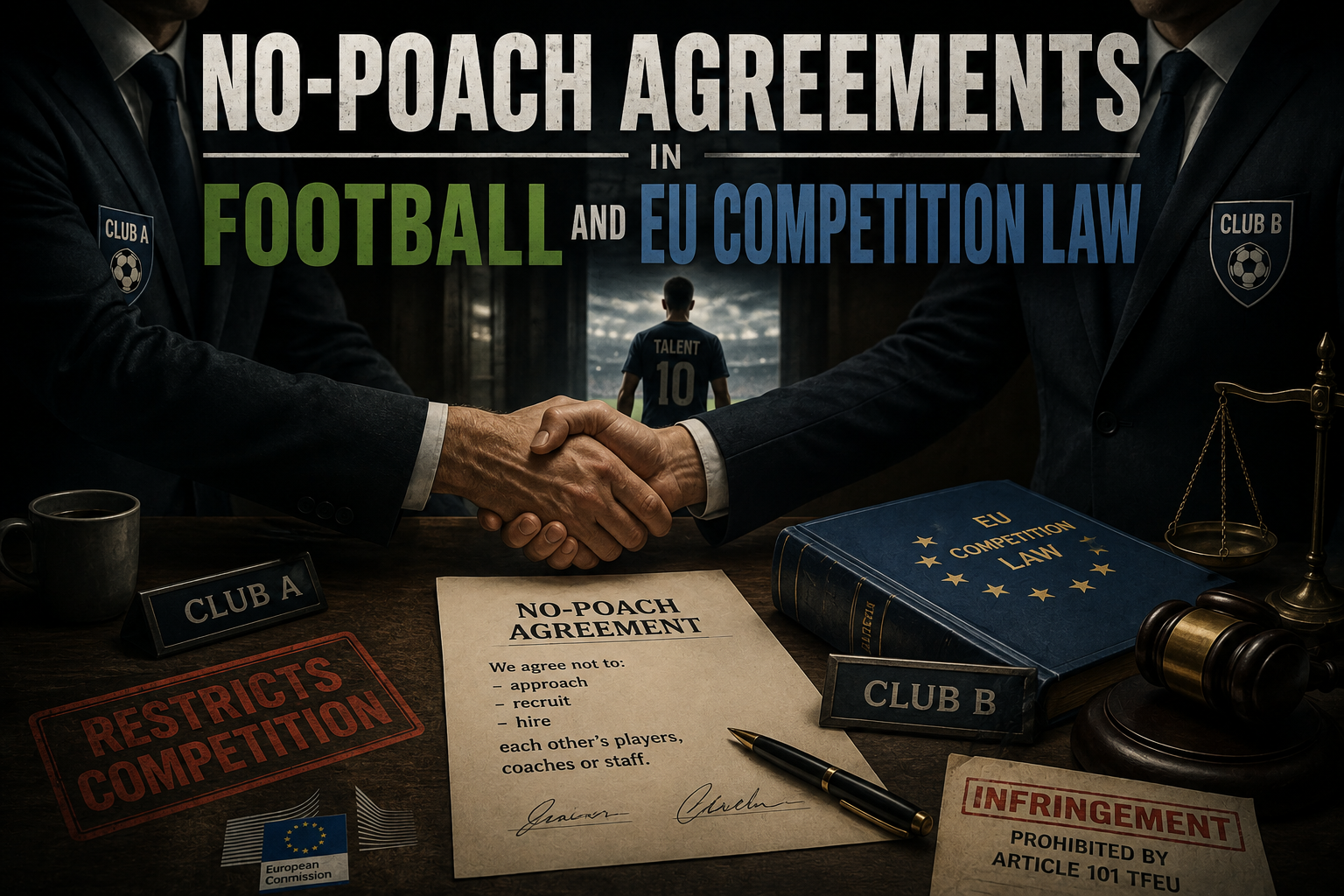
So-called ‘no-poach agreements’ are used, from time to time, in association football, particularly in crisis situations.
They are agreements between clubs not to solicit or hire one another’s players. Once mainly confined to the corporate world, such agreements are now drawing attention in the sporting world, particularly under EU competition law, as their restrictive effect on player mobility can distort competition within the sports’ labour market.
As such, they are generally regarded by the European Commission as restrictions “by object” under Article 101(1) of The Treaty on the Functioning of the European Union (TFEU); that is, they are presumed to be inherently anticompetitive and, therefore, unlawful, without the need to demonstrate such effects.
They recently came to prominence in the CD Tondela Case (CD Tondela and Others v Autoridade da Concorrência) (Case C-133/24), which arose from a request for a preliminary ruling by the Court of Justice of the European Union (CJEU), which was lodged on 16 February 2024 by the Tribunal da Concorrência, Regulação e Supervisão.
The Case arose from the COVID-19 pandemic and, in April 2020, several Portuguese football clubs, under the auspices of the national football authorities, entered into no-poach agreements.
The stated objective of entering into the no-poach agreements was to prevent the Portuguese football clubs from hiring players, who had unilaterally terminated their contracts, due to the disruptions caused by the pandemic, whilst the 2019/2020 season, extended beyond the usual calendar, due to health-related restrictions, was still ongoing.
The main concern was that wealthier clubs might exploit the prolonged season to poach key players from financially vulnerable rivals, thereby distorting the sporting results in the decisive final matches. The stated objective, as noted by Advocate General Emiliou, who was assigned to the Case, was to safeguard the integrity and fairness of competition, whilst the season was still ongoing under such extraordinary circumstances.
Previously, in 2022, the Portuguese Competition Authority had condemned the no-poach agreements as restricting competition “by object” under Article 101(1) TFEU and imposed financial penalties on the Portuguese football clubs.
The preliminary reference sought guidance from the CJEU on whether such no-poach agreements should be regarded as restricting competition “by object” under Article 101(1) TFEU; or whether, in view of the specific sporting context and underlying objectives, such agreements might fall outside the scope of that Article by virtue of the Meca-Medina doctrine, which permits restrictive agreements to escape the scope of Article 101(1) TFEU when they pursue legitimate public interest objectives and meet the tests of necessity and proportionality.
On 30 April 2026, the CJEU handed down its ruling in the Case, stopping short of a blanket ban or automatic immunity, and leaving the final proportionality assessment to be made by the national referring court.
For sports governing bodies, the Case is a timely reminder: labour rules and crisis-response measures cannot be insulated from EU Competition law. Any arrangements restricting football players’ movements—even when well-intentioned—must be assessed not only in the light of their purpose, but also their scope, proportionality, and available alternatives. The line between legitimate governance and unlawful collusion remains a fine one in practice.
For sports law practitioners, crisis-management measures, transfer rules, and internal policies affecting players mobility must be designed with close attention to proportionality and necessity and should ideally be subjected to prior legal assessment to ensure their compatibility with Articles 101 and 102 TFEU. This is particularly important where cooperation between clubs is contemplated, even temporarily or in response to exceptional circumstances.
All in all, the CJEU ruling in the Case is a reminder that exceptional circumstances do not, per se, exempt sports regulation from the discipline of EU competition law.
We advise and represent clients in EU competition law cases, and further information is available from our International Sports Law Consultant, Prof Dr Ian Blackshaw by emailing him at blackshaw@valloni.ch.