
SPAIN: BASKETBALL PLAYERS’ EMPLOYMENT CONTRACTS
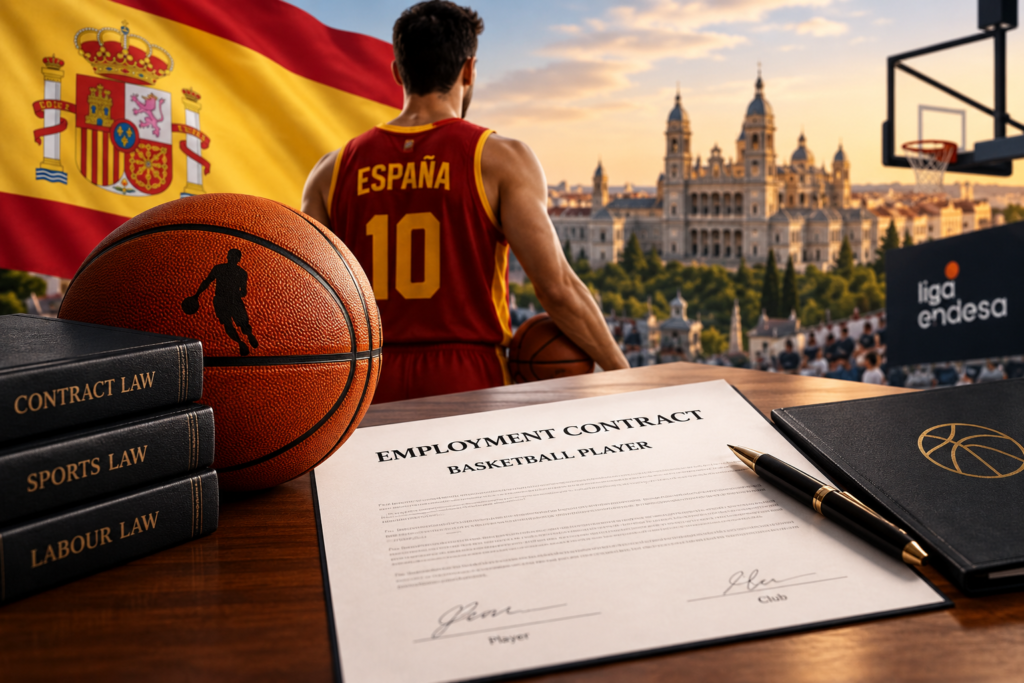
Professional basketball players in Spain are employees, but they are not ordinary ones.
Their contracts are governed primarily by Royal Decree 1006/1985 (RD 1006/1985), which regulates the special employment relationship of professional athletes. The Workers’ Statute (Royal Legislative Decree 2/2015) applies as supplementary law, where RD 1006/1985 is silent and the rules are compatible, and the applicable collective agreement, such as that of the Association of Basketball Clubs (ACB) in the topflight, completes the legal framework.
Form and duration
The contract must be in writing and state the parties; its purpose; the remuneration; and its duration (Article 3). It must always be for a fixed term, either for a set period or for a number of sporting performances (Article 6): indefinite contracts are not legally possible. Extensions are agreed successively, each for a further fixed term, unless a collective agreement provides otherwise. A probation period of up to three months may be agreed (Article 5).
Minors
RD 1006/1985 does not set a minimum age itself; therefore, the Workers’ Statute applies. In general, no one under 16 may be employed, and minors aged 16 to 18 require the authorisation of their parents or legal guardians. The participation of under-16s in public performances is only exceptionally authorised by the labour authority.
A recent, widely reported case shows how demanding this legal framework is in practice. An under-16 prospect of a leading Liga Endesa club reportedly has the support of the Spanish Basketball Federation, the Spanish Sports Council and the regional labour department, but cannot be registered for ACB and EuroLeague competition, because the Social Security authorities have refused to register him under the exception used for public performers, taking the view that he is an athlete. As the ACB requires Social Security registration before it issues a licence, the player is, for now, unable to make his professional debut.
The lesson for clubs and agents is that labour authorisation, sports approvals and Social Security registration are separate steps, and all three must be addressed before an under-16 player is planned into a professional squad.
Pay and rights
Everything a player receives from the club in cash or in kind as consideration for his services is salary (Article 8). Players are entitled to effective occupation, meaning that they cannot be excluded from training except for sanction or injury (Article 7), and to 30 calendar days of paid holiday (Article 10). Since August 2024, Organic Law 2/2024 has added provisions on pregnancy and adoption, work-life balance and equality plans, including an automatic one-year extension for players in the last year of their contracts.
Loans, transfers and buyouts
A club may loan a player only with his express consent, and, if the loan involves payment, the player is entitled to an agreed share of not less than 15% of the gross amount (Article 11). The same 15% applies by default where the contract ends by mutual agreement for a definitive transfer (Article 13). In practice, clubs and players often agree specific arrangements, which should be drafted with care.
If a player terminates without cause attributable to the club, the club is entitled to the compensation agreed in the contract, such as a buyout clause, or otherwise to an amount fixed by the labour court, having regard to the sporting circumstances; the damage caused; and the reasons for the termination (Article 16). If the player signs with another club within a year, that club is subsidiarily liable for the payment.
Conversely, a player may seek termination on the grounds of Article 50 of the Workers’ Statute, such as unpaid salary, with the effects of an unfair dismissal: by default, at least two months’ salary per year of service (Articles 15 and 16). Courts also scrutinise termination clauses: in 2022, the High Court of Justice of the Canary Islands treated an impossible resolutory condition as not written and the termination as an unfair dismissal.
Dispute resolution
Under Article 19, disputes between players and clubs arising from the employment contract fall under the labour jurisdiction. Claims are brought before the labour courts, in general after a mandatory attempt at conciliation, and the time limits are short: a dismissal, for instance, must be challenged within 20 working days.
Players, therefore, should document any default, such as late or unpaid salary, from the outset and seek advice promptly, particularly where termination under Article 50 of the Workers’ Statute is being considered. Where the player or the club is not Spanish, applicable law and jurisdiction should also be reviewed at the drafting stage.
The same logic applies to arbitration clauses in athletes’ employment contracts. Dr. Lucien Valloni experienced this as the lawyer of the Phonak cycling team: a rider who did not accept the clause in favour of the Court of Arbitration for Sport brought an employment claim before a court in Madrid and succeeded on the question of jurisdiction.
Clubs and agents should not, therefore, assume that an arbitration clause will prevent a player from turning to the Spanish labour courts for the resolution of their cases.
We advise players, agents, coaches and clubs on basketball employment contracts and disputes under Spanish law, including cross-border situations, and further information is available from the Head of our Spanish Law Practice, Pablo Pérez, by emailing him at perez@valloni.ch.