
FIGHTING MONEY LAUNDERING IN SPORT IN TÜRKİYE
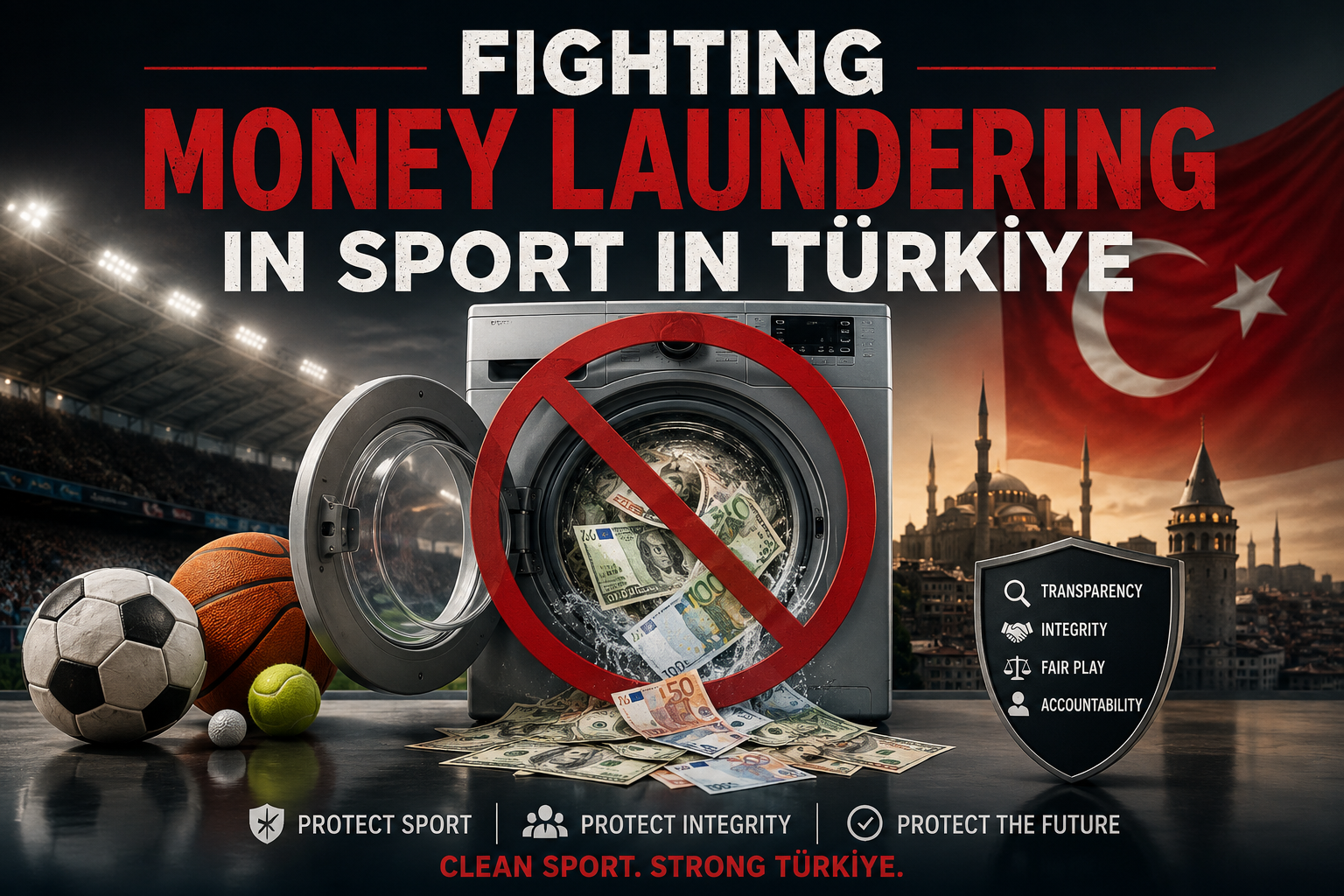
An internal audit launched by the Turkish Football Federation (TFF) at the end of 2024 into referees’ betting activity found that, of 571 registered referees, 371 held betting accounts, and 152 of them had actively placed bets on domestic matches.
Following this finding, the TFF initiated disciplinary proceedings, whilst judicial authorities separately opened an investigation into allegations of money laundering. By November 2025, more than 1,000 football players had been referred to the disciplinary board, and, since late 2024, numerous referees, club presidents, and footballers have been detained or arrested.
Investigation files allege that proceeds derived from betting-related activity were layered through club-affiliated bank accounts, virtual point-of-sale systems, jewellery businesses, and cryptocurrency platforms, with certain licensed payment institutions allegedly acting as intermediaries in this process.
The financial intelligence unit in Türkiye, MASAK, completed 502 analysis files related to illegal betting during 2025 and suspended accounts holding approximately 5.1 billion Turkish lira (around Sw. Frs. 87.48 billion) in connection with these files.
The Legal Framework
Money laundering offences connected with sport in Türkiye are not addressed under a single statute but under several interrelated, and partly overlapping, specific laws and administrative regulations.
Article 282 of the Turkish Penal Code: Laundering of Proceeds of Crime
- Elements of the Offence. The offence set out in Article 282 of the Turkish Penal Code (TCK), colloquially referred to as “money laundering,” requires the existence of a “predicate offence.” The assets subject to laundering must derive from an offence carrying a minimum sentence of one year’s imprisonment or more. The conduct consists of (i) transferring such assets abroad, or (ii) subjecting them to various transactions with the purpose of concealing their illicit origin or creating the impression that they were legitimately acquired. Under prevailing doctrine and case law, a final conviction for the predicate offence is not a precondition; the laundering offence may be assessed independently upon a finding that the predicate offence was committed.
- Penalty. The basic form of the offence carries a sentence of three to seven years’ imprisonment together with a judicial fine of up to 20,000 day-units. The penalty is increased where the offence is committed by a public official or a member of certain professional groups. Article 282(2) separately, and less severely, penalises the act of knowingly purchasing, accepting, possessing, or using assets subject to laundering; these acts are prosecuted ex officio, without requiring a complaint.
- Effective Repentance. Under Article 282(6), a perpetrator who enables or facilitates the seizure of the laundered assets is not subject to punishment. This provision functions as a personal ground for impunity intended to encourage cooperation with investigating authorities.
Law No. 5549 on the Prevention of Laundering Proceeds of Crime and the Powers of MASAK
- Function of the Law. Law No. 5549 forms the administrative-preventive arm of the Anti Money Laundering regime and governs the duties and powers of the Financial Crimes Investigation Board (MASAK).
- Obligated Institutions. Banks, payment institutions, electronic money institutions, and following Law No. 7518 crypto-asset service providers are required under the law to file suspicious transaction reports.
- Freezing Power (Article 19). Article 19 of Law No. 5549 grants MASAK the power to impose an administrative freeze following a suspicious transaction report. The freeze initially lasts seven business days but may be extended by a public prosecutor’s decision or an interim measure ordered by a magistrate’s court. This mechanism allows for rapid administrative intervention without awaiting a court judgment, and is particularly significant in relation to fast-moving cryptocurrency transfers.
- Process for Lifting a Freeze. A person or entity whose account has been frozen is expected to apply to MASAK and the relevant prosecutor’s office with documentation proving the legitimate source of the funds (payslips, tax returns, bank or crypto-exchange transaction records), and to clarify their procedural status as complainant or suspect in the file.
Conclusions
Turkish legislation offers a quantitatively broad set of criminal and administrative sanctions against sports-related money laundering, through the combined application of Article 282 of the TCK; Law No. 6222; Law No. 7258; Law No. 5549; and Law No. 7518.
The most notable strength of this legal framework is that it allows both predicate offences and the laundering act itself to be prosecuted separately, and permits administrative and criminal sanctions to proceed in parallel without either displacing the other.
At the same time, certain structural weaknesses affect the framework’s practical operation. Foremost among these are the technical difficulty of proving predicate offences; inadequate ownership vetting at the company and payment-institution formation stage; the fact that cross-border platforms fall outside Turkish jurisdiction; and the incomplete state of legislation addressing newer typologies, such as rented accounts.
On this basis, the effectiveness of the fight against money laundering in sport would be enhanced by supplementing the framework’s largely detective (ex post) character with stronger preventive (ex ante) mechanisms, in particular, more rigorous beneficial-ownership verification and improved coordination amongst the relevant authorities.
We advise and represent clients in money laundering cases in Türkiye and further information is available from the Head of our Turkish Law Practice, Gurur Gaye Günal, by emailing her at gunal@valloni.ch.